

Don't fall for this PR trap
The PR industry sometimes receives a bad rap as ‘spin doctoring’. Well, in the case of AVE (Advertising Value Equivalents) this label is justified. AVE’s are a method used by some PR agencies and practitioners to evaluate media coverage for a client. In reality it is all smoke and mirrors. Here’s why. AVE’s are used to calculate how much it would cost in advertising spend to purchase the same space or time in editorial content. So, if a story appears on page three of a major newspaper, and displayed prominently on its online platform, the cost is estimated in advertising spend. But wait, there’s more. Because editorial has gone through the journalistic process it is more credible than advertising. That credibility is then weighted as a percentage added to the advertising spend. The figures are impressive – $500,000 worth of free publicity a client is told. Here’s where the spin comes in. What difference has that made? Did it change opinions, behaviour and so on? Well outcomes are not part of the equation. In any case, how can PR agencies compare advertising with editorial? There is no valuation of the content. How much of the coverage was devoted to the client? Was it negative, positive or neutral? How much space was devoted to competitors (for example a product review)? How accurate was the story? In other words, the $500,000 worth of ‘free publicity’ may be worthless. In our view, AVE’s are an unethical practice which brings the PR industry into justifiable bad repute.

Political web for corporates
If you don’t think that a corporate crisis attracts political interest, think again. Political leaders can and do step into a corporate crisis when the situation is attracting significant media and public interest. After all, they are the people who elect politicians, who want to be seen taking action. That could involve making public statements to changing legislation. For example, in Auckland, Mercury Energy was roundly criticised by the New Zealand Prime Minister for failing to act in the interests of its customers. In Australia, the Sizzler restaurant chain was criticised by the Health Minister for failing to report deliberate food contamination in a timely manner. Legislation was changed to enforce time limits for such incidents. How do corporate leaders – and those charged with disaster response – manage the political minefield? The answer is in this book, authored by Dr Hamish McLean and Prof Jacqui Ewart, which delivers a roadmap on the blame game, finger-pointing, back-stabbing and intense pressure when information, resources and time is scarce.
Political Leadership in Disaster and Crisis Communication and Management, published by Palgrave Macmillan, has lifted the lid on how political leaders maintain public trust and confidence in very uncertain times. It is this understanding which will help corporate leaders when calamity strikes.
Political Leadership in Disaster and Crisis Communication and Management, published by Palgrave Macmillan, has lifted the lid on how political leaders maintain public trust and confidence in very uncertain times. It is this understanding which will help corporate leaders when calamity strikes.

Give boring the flick
Speech writing is both an art and science. It can’t be written quickly nor should a speech be impromptu – unless you are very experienced. Here are our five tips on effective speeches:1. Long is wrong. Very wrong. The famous Gettysburg address was only minutes, yet conveyed significant meaning.2. Tell a story. Let us repeat – tell a story. A lecture-style speech is going to turn off your audience. People love stories. Tell a good one.3. Write for the ear not the eye. Read your speech aloud. Does it flow? Does it engage? Does it mean something?4. Don’t pack in too much. Make two or three main points and make them well. The mind can only absorb so much.5. Start by engaging your audience. Ask a question. Tell of an experience – just whatever you do, don’t apologise for your speech.
We provide workshops on speech writing where our team explores the use of triads – it is a simple but effective technique for audience understanding and recollection.

How issues become crises
Henry Kissinger once said: ‘There cannot be a crisis next week. My schedule is already full’. Failure to manage issues is an invitation to calamity. Many organisations we have assisted during a crisis look back and ask: ‘why didn’t we see that coming. it is so obvious now’. Hindsight provides lessons, but does not obviously look at what is on the horizon. Issues have a lifecycle. Why is this important. To understand the lifecycle provides an opportunity to intervene at the second phase and prevent a crisis. It provides an argument that burying heads in the sand in the hope it will go away does not wash.The embryonic phase is when something is going wrong. Maybe it is a reported product issue to your call centre? It is noted but not rectified. The emerging phase lands when more calls are received. Something needs to be done now. It is this phase that resolution is under the control of the organisation. The third phase – the public sphere – where the media (social and traditional) light up the organisation for all the wrong reasons. The issue now evolves into a crisis gaining intensity and threatening the organisation’s operations and reputation. Competitors, critics, keyboard warriors join the fray. The organisation is fighting for survival, let alone trying to resolve the situation which is all-consuming. The fourth phase – external – happens when the resolution is imposed, usually at the political or regulatory level on the organisation, and it may not be in its favour.
Disaster mystery
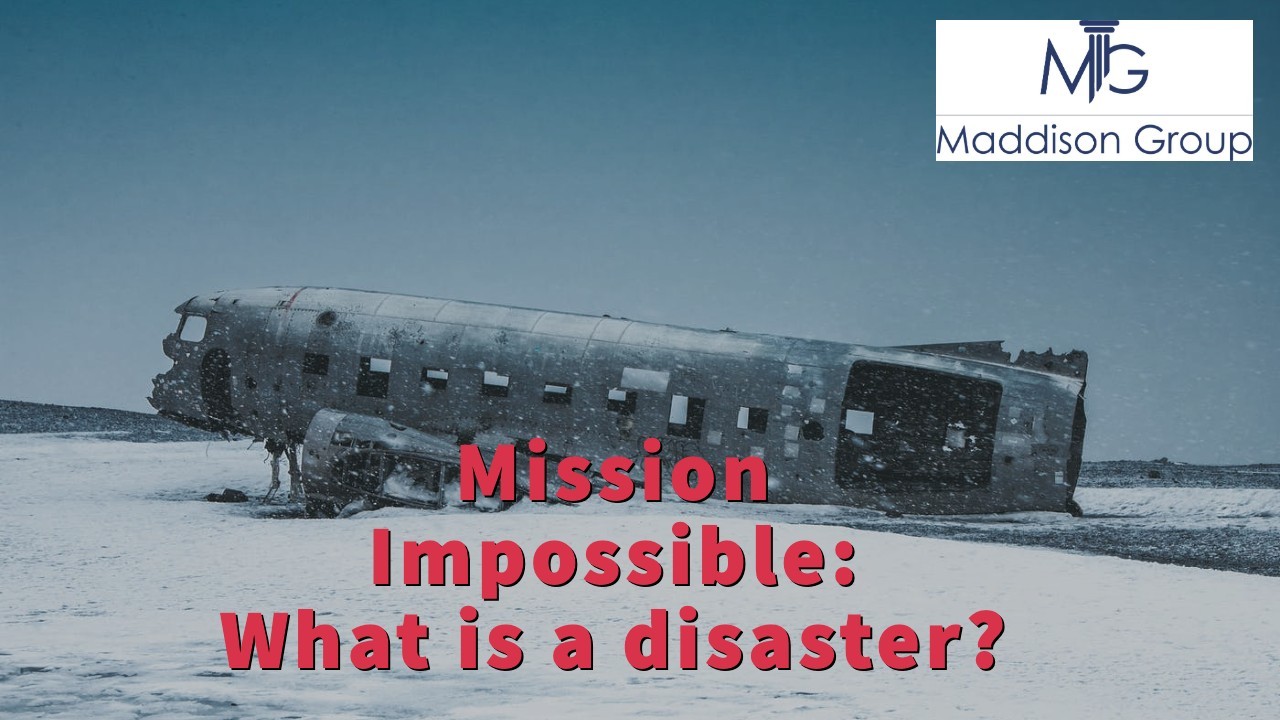
This is an interesting question because there is no agreed definition of a crisis/disaster. While practitioners may not be that interested in definitions, we think it is important to find out what are the common elements of a crisis. It provides a basis on which to develop strategies to manage the crisis. So, here are the common elements (across a myriad of definitions):> Uncertainty (reduced by a crisis plan and team exercise)> Surprise (reduced by an issues management system)> Danger (reduced by effective decision-making)> Reputation (protected by the above)> Stakeholders (information and actions that meet their expectations)